100+ articles. 610 ranking keywords. Cited by the U.S. Senate.
SoFi is a publicly traded fintech platform offering banking, investing, and lending products. I wrote 100+ long-form articles for SoFi Learn from 2020 to 2023, covering personal finance, investing, and cryptocurrency.
Two articles illustrate the range of results.
1) Bitcoin Price History: 2009 to 2025
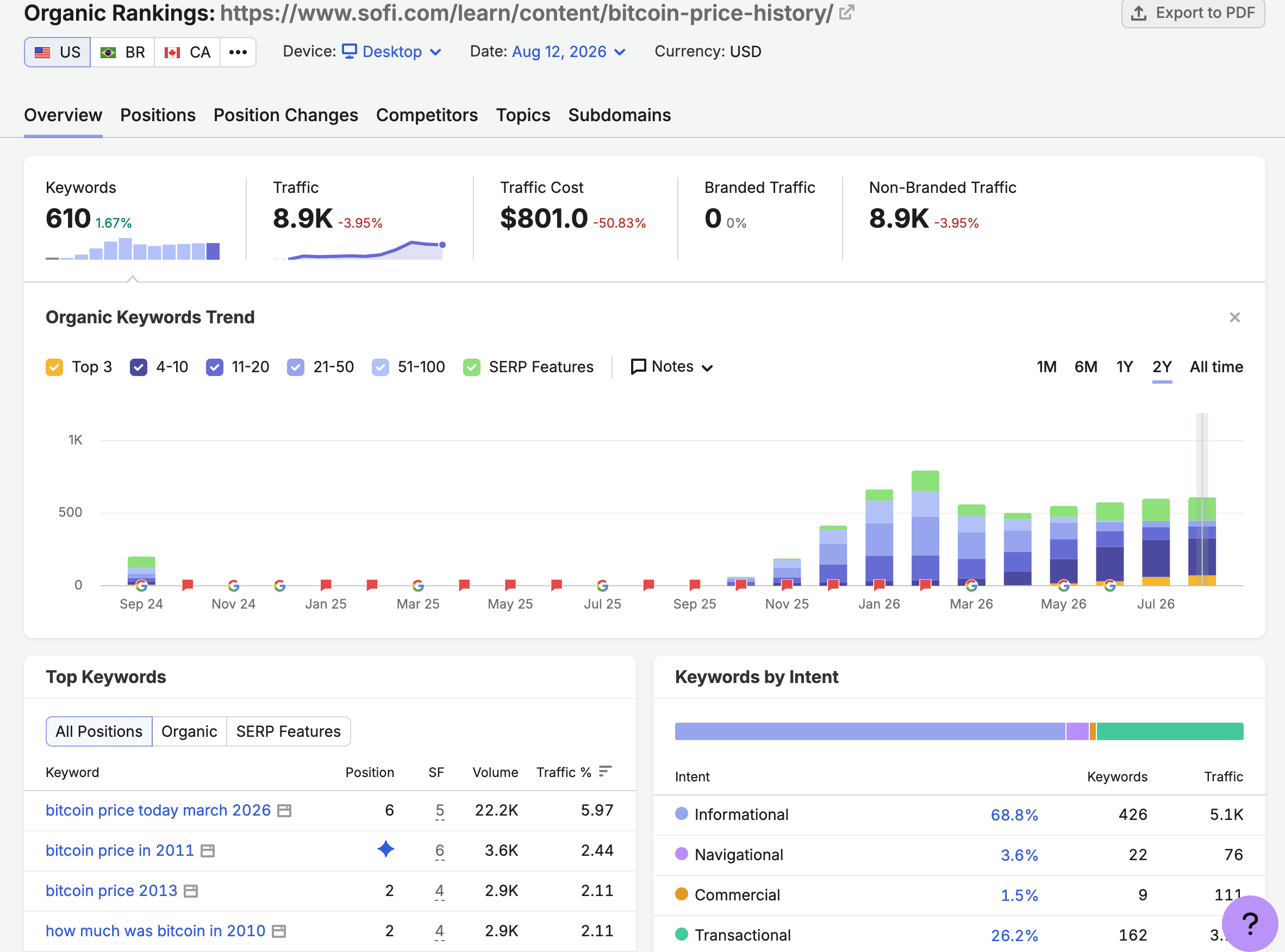
This article ranks for 610 organic keywords and pulls 8,900 monthly visits, generating a traffic value of $801/month (roughly $10K/year in equivalent ad spend).
It currently sits as the #7 highest-traffic page on SoFi's entire /learn subdomain, which contains hundreds of articles written by dozens of contributors.
| Keyword | Monthly Volume | Position |
|---|---|---|
| bitcoin price today march 2026 | 22,200 | 6 |
| bitcoin price 2013 | 2,900 | 2 |
| bitcoin price in 2011 | 3,600 | 6 |
The keyword trend chart shows near-zero traffic for years, then explosive growth beginning in September 2025. I originally wrote this article in 2022. It required no additional promotion or link building. Compounding organic returns from evergreen content did the work.
2) What is the Black-Scholes Model?
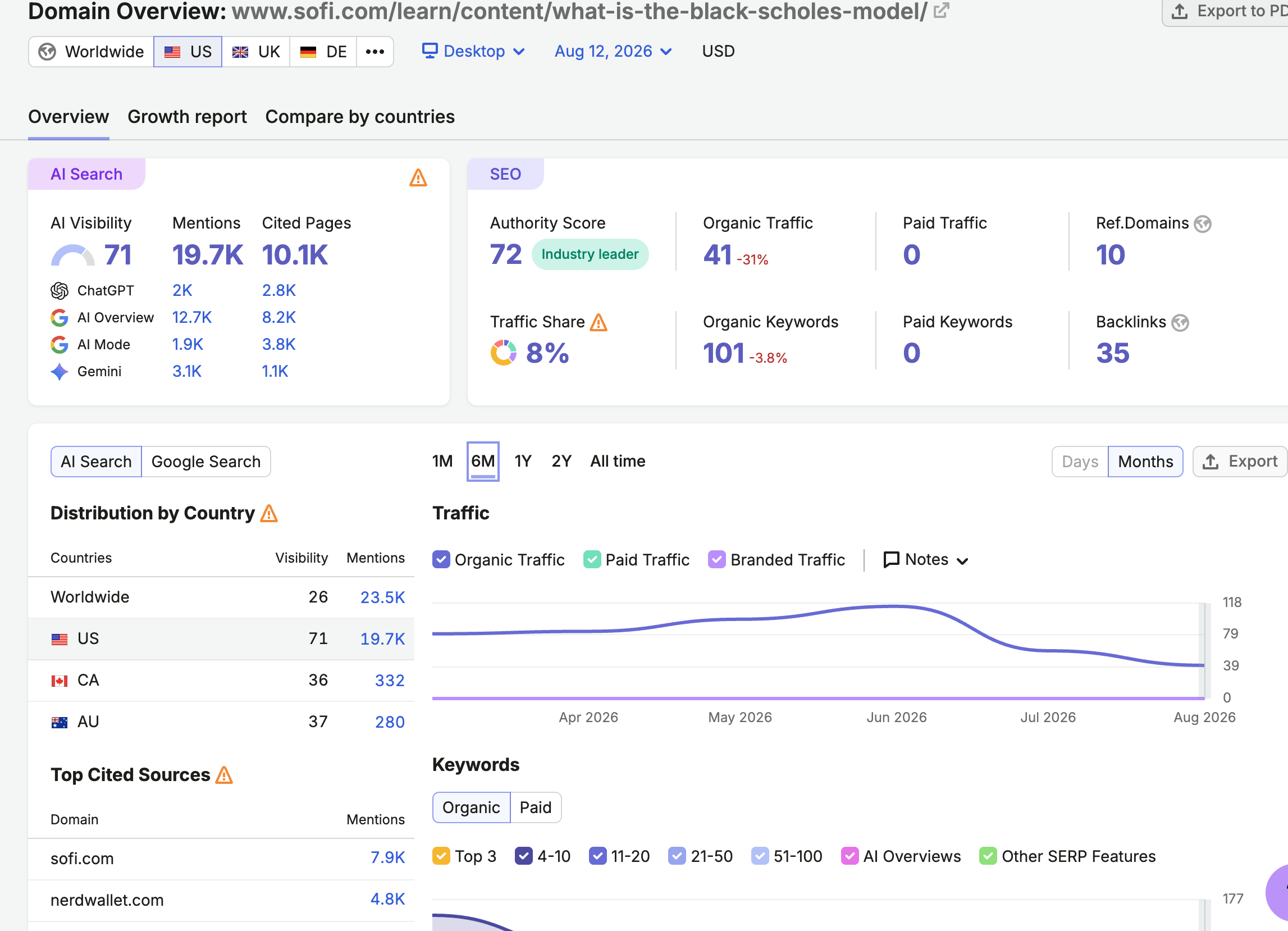
This article demonstrates a different kind of authority. SEMrush assigns it an Authority Score of 72 with an "Industry Leader" badge, the highest of any article in this case study.
Its AI Visibility score is 71, also the highest across all articles featured here. AI platforms have cited the page 19,700 times:
| Platform | Citations |
|---|---|
| Google AI Overview | 12,700 |
| Gemini | 3,100 |
| ChatGPT | 2,000 |
| Google AI Mode | 1,900 |
The article also holds 101 organic keywords and 35 backlinks from 10 referring domains. For context on the AI citations: the top-cited source for this topic across AI platforms is sofi.com with 7,900 mentions. The second is nerdwallet.com with 4,800. SoFi's content, including this article, is cited alongside the most established name in personal finance publishing.
These two articles together show range. The Bitcoin Price History page proves traditional SEO strength on a crypto topic. The Black-Scholes page proves AI search authority on a quantitative finance topic.
Beyond SEO: Cited in Legal Scholarship and Government Filings
Content I wrote for SoFi and Business Insider has been formally cited in the Duke Law Journal, the William & Mary Business Law Review, the Fordham Law Review, in U.S. Senate Banking Committee correspondence to federal regulators, and in SEC regulatory filings regarding Bitcoin ETF approvals.
LAW REVIEWS AND ACADEMIC JOURNALS
- Fordham Law Review (Vol. 91, 2023) cited "Bitcoin Price History: 2009–2023" (SoFi) in a paper titled "Ripple Effect: The SEC's Major Questions Doctrine Problem." The article appears in the same footnote as the Satoshi Nakamoto Bitcoin whitepaper. (Source)
- Duke Law Journal Online (Vol. 72, Oct 2022) cited "Proof of Stake: A Process Used To Validate Crypto Transactions Through Staking" (Business Insider) in "Cryptocurrency, Legibility, and Taxation" by Amanda Parsons, Associate Professor at the University of Colorado Law School. A law professor at a top-15 research university chose this explainer over all other available sources to define proof-of-stake for a legal audience. (Source)
- William & Mary Business Law Review cited "Simple Guide to Buying, Selling, and Making NFTs" (SoFi). (Source)
- Lewis & Clark Law School cited "What is a Utility Token" (SoFi) in a paper on prohibiting purely speculative cryptocurrencies.
GOVERNMENT AND REGULATORY FILINGS
- U.S. Senate Banking Committee cited "Pump and Dump Schemes in Crypto: An Overview" (SoFi) in two separate letters: one addressed to SoFi (Source), and one addressed to the Federal Reserve, the FDIC, and the OCC (Source).
- Better Markets cited "Bitcoin Price History: 2009–2023" (SoFi) in an SEC comment letter filed during the Bitcoin ETF approval process. (Source)